The StarShip simulator itself, of course.
The simulator itself has 3 consoles in front of a chair. The chair can rotate in the horizontal plane so that
the captain in the seat can sit comfortably in front of the console that needs his attention. A small panel
at the right side of the chair has a few switches that activates a motor to move the chair to the consoles or
away from the consoles. This makes getting in and out of the StarShip easy.
The simulator main computer.
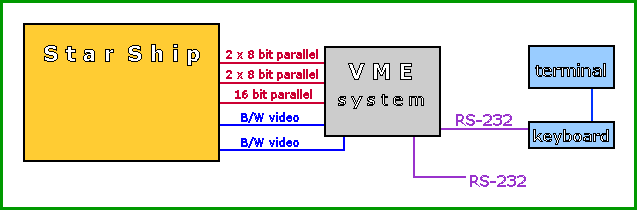
The main computer is a VME rack based processor board with a Motorola 68020 CPU clocked at 30 MHz. On the
processor board is also integrated 4 Mbytes on dynamic RAM (at 1 wait-state), a simple monitor in EPROM, two
RS-232 serial communication lines and a 3½" high density floppy disk interface.
Additional boards in the VME rack are the following:
EPROM board, start address at $600000
RAM board, start address at $400000
2 home-made boards each has 16 bit parallel I/O and a simple 512 dots x 256 line B/W video generator
1 home-made board that has a 16-bit parallel I/O with handshake and a SP0256-AL2 phoneme (speech) generator
I got from eBay an 68040 VME board and in the future I will investigate how much performance gain this board will
give over the current 68020 board. If I choose the 68040 board I will have to make a few adaptations to the system
software. However, a nice thing to mention is that the 68040 CPU is also used in the X-38 "Crew Return Vehicle" (CRV) of
the International Space Station, ISS. The X-38 is a 'life boat' to return 7 astronauts safely to Earth in case of an
emergency.
The Motorola 68040 of the X-38 is clocked at 33 MHz and runs the Wind River OS (VxWorks 5.4) and is reponsible for
navigation, flight control, life support, communication and propulsion when the Vehicle leaves the orbit.
The simulator controller console.
This is a video monitor for a standard analog video signal and a keyboard.
The keyboard is home-made from a Keytronics ASCII keyboard and a video controller single board computer
(Solder It Yourself kit) with the Intel CRTC and an F8 microprocessor. I bought the source listing of the firmware
and made a few modifications to the code to support a sort of a "status line". I have this keyboard/video kit
since 1978 as the original interface to my first home-made computer, Motorola 6800 based. Intel has never
convinced me to their instruction set, duh.