
| DATAPOINT |
|

Here's the story as Rody told me.
The Datapoint 1550 is purchased by the company around 1985. Its purpose was payroll administration for the employees of the
construction company. This was in cooperation with a company called "CTB (Computer Toepassing Bouwwezen)" in the city Ede.
Originally, the system also had a modem, but that unit disappeared many moons ago. Every week, the hours worked by the employees
were entered into the system and "transmitted", as the guys would name it. I think, my father was very progressive. Much of his
free time went into playing with the computer. I inherited the enthusiasm my father had for computers -- as a child I wrote my
first programs in BASIC on that computer! After a few years, the Datapoint was replaced, but I kept the system in my
sleeping room for quite a while. In the end, computer programming became my profession ...! My father was in contact with
a professor of the University of Amsterdam (in the city Diemen), who wanted to take the computer. However, this fell through.
Summarized, the rest of the journey of this Datapoint has been "stored in some attic".
I think the computer is no longer working. That is my conclusion after I hooked up the floppy disk drive to the terminal and
applied power to it. You can hear some humming, but the screen remains blank. The connection cable is stored behind a panel at
the rear side of the floppy disk unit. You need to loosen a few screws if I remember correctly. I am not sure whether the
connection cable for the printer is also stored behind that panel. For the rest, I did not see any parts during the move.
My father once told me that the cable (if I remember, 80 pins) has gone bad over time. One single damaged wire will cause a
malfunction of the computer.
Stefan picked up the Datapoint 1550 while I was not at home, and it was done in sort of a hurry. In that hurry not everything
was packed. I still have a stack of floppy disks and a map filled with documentation. Whether the disks can still be read
remains to be seen ... you are welcome to it all. For me, this machine had (and still has) an emotional value. It would be
great if the system could be restored to working order. Let me know!
PS. There is also a page on Facebook,
Datapoint Nederland BV ! It is not a very
active page. We posted a message on it, but never got any response ...
The computer system was indeed of my father, or better said, of the company for which he worked, "Bouwbedrijf Gebr. Schram" in the
city Beverwijk. Unfortunately, the company went bankrupt in the end of the nineties, but he saved the Datapoint and a (still working)
original IBM XT from scrapping. My father died 3 years ago (it is now 2017), and both systems have been stored those 3 years in the
attic of mother's house. Recently, my mother moved to a smaller house, and new space had to be found for the computers. For me
(Rody) it was no option that the Datapoint would disappear in the dumpster, but I could not store the system myself (no room for
it, or my wife would not let me
 ). So, I am very happy that I found somebody who has the space
for it, but it was a close call!
). So, I am very happy that I found somebody who has the space
for it, but it was a close call!
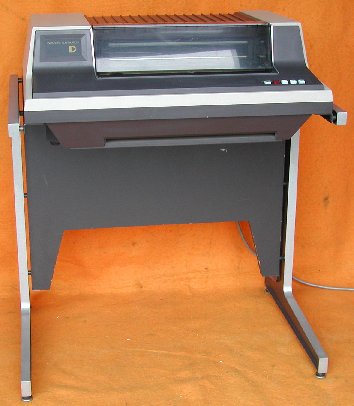
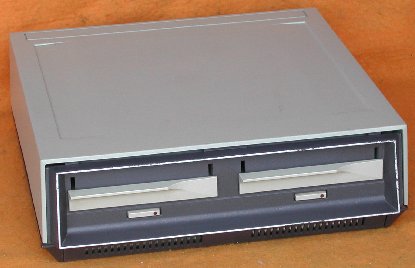
This Datapoint 1550 system came in 8 parts. The computer itself with CRT screen and keyboard integrated in one unit, The dual 8
inch floppy disk drive unit, the printer, and 5 parts that make a table, two vertical stands, a "cross-connection" plate to
link the two vertical stands together, and 2 metal strips that are mounted on the vertical stands and on which the printer is
placed.
The two vertical stands are bolted together with the "cross-connection" plate using 3 M6 black hexagonal screws on each side. The two metal strips are mounted on the inner side of the vertical stands with one M6 black hexagonal screw on each end. The printer is placed on the metal strips and is held in place with two screw at each corner. The original screws where gone, so I used screws for the PDP-11 "spares box".
 |
 |
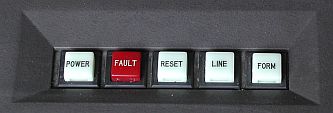
| Logo on the printer | Printer control panel |
|---|
  |
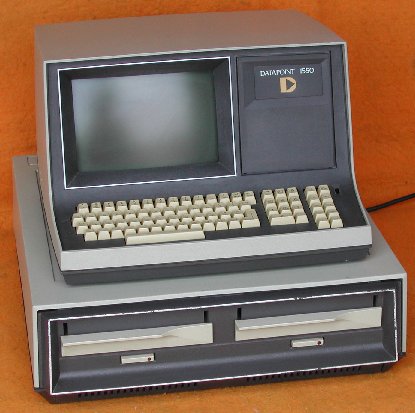 |
The Datapoint 1550 computer *looks* like a standard terminal, that is, it has a keyboard and a screen, just like all other terminals from that time. The keyboard cannot be detached from the screen, just like the famous ADM-3A (to name an other famous terminal). In that respect, the guys from Datapoint managed to develop a TeleType replacement while hiding that in fact it is a computer!
More to come ...
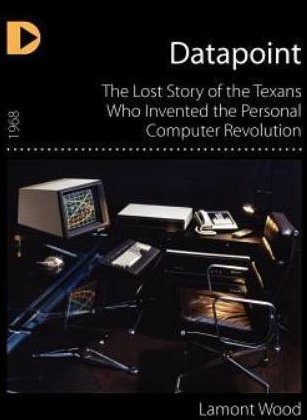
After reading the article on Wikipedia about Datapoint Corporation, I wanted to know more about this pioneer in the computing
industry. The guys of Computer Terminal Corporation, which became later Datapoint, had some brilliant ideas, and maybe they
were the forerunners of what became the Personal Computer!
As said, the Wikipedia page is a very interesting read!
A quick search on eBay resulted in a few booksellers that had a copy of this 330 pages book in store. I ordered a copy from a seller that did ship "overseas". It is amazing how many companies see USA as "the world". They miss sales from countries that are not "USA". Or they are just too lazy to do some extra paperwork. Maybe they don't need too much sales ...

From the back cover from the book “Datapoint, The Lost Story of the Texans Who Invented the Personal Computer Revolution”,
Lamont Wood, ISBN 978-1-936449-36-1.
Forget Apple and IBM. For that matter forget Silicon Valley. The first personal computer, a
self-contained unit with its own programmable processor, display, keyboard, internal memory, telephone interface, and mass
storage of data was born in San Antonio, Texas.
The story begins in 1968, when two Texans, Phil Ray and Gus Roche founded a firm called Computer Terminal Corporation.
As the name implies their first product was a Datapoint 3300 computer terminal replacement for a mechanical Teletype.
However, they knew all the while that the 3300 was only a way to get started and it was cover for what their real intentions
were - create a programmable mass-produced desktop computer.
They brought in Jack Frassanito, Vic Poor, Jonathan Schmidt, Harry Pile and a team of designers, engineers and programmers to
create the Datapoint 2200. In an attempt to reduce the size and power requirement of the computer it became apparent that the
2200 processor could be printed on a silicon chip. Datapoint approached Intel who rejected the idea as a "dumb idea" but were
willing to try for a development contract. Intel belatedly came back with their chip but by then the Datapoint 2200 was already
in production.
Intel added the chip to its catalog designating it the 8008. A later upgrade, the 8080 formed the heart of the Altair and IMSI
in the mid seventies. With further development it was used in the first IBM PC - the PC revolutionary's chip dynasty.
If you're using a PC, you're using a modernized Datapoint 2200.
| Back to top |