FREQUENCY CONVERTER

|
RA.70A FREQUENCY CONVERTER |
|
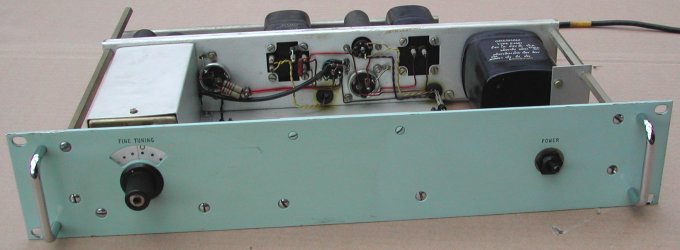
Other variant of the RA.70A
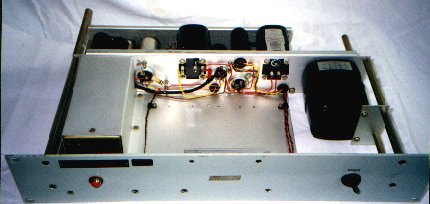
As you can see on the picture, there is an other variant of the RA.70A. This version, called RA.70, does not have the
fine tuning knob available with the illuminated fine tuning scale. With this fine tuning facility you can slightly
change the local oscillator frequency that mixes the 100 kc/s signal from the receiver to the 14 kc/s output
frequency of the RA.70A for the Plessey FV.78B unit.
Instead of the fine tuning, a power on indicator is fitted on the front to show that the unit is switched on.
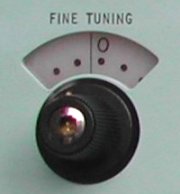
The early RA.70A units had this fine tuning facility to adjust the mixer tuning, but subsequent models RA.70
dispensed with this. Firstly, because it encouraged unauthorized knob twiddling, which the legitimate operator
was unlikely to notice and more significantly, because it was found that in practice, this fine tuning facility
was not required when the unit was used as intended.
The Plessey FV.78B was the RACAL prefered unit for TTY reception/decoding together with two RA.70 units and two
RA.17 or RA.117 receivers in diversity set up.
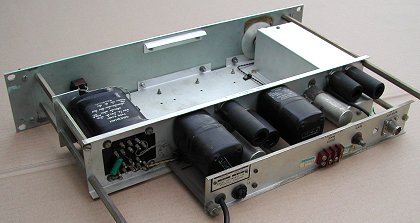 The 75 Ohms (unbalanced) signal at 100 kc/s from the receiver is fed to the input plug PL1 of the RA.70. Via a
preset input level potentiometer this signal goes to a mixer stage. The output of an 86 kc/s oscillator is
also fed to the mixer stage. The resultant 14 kc/s output signal passes though a low-pass filter and amplified
by an output stage.
The 75 Ohms (unbalanced) signal at 100 kc/s from the receiver is fed to the input plug PL1 of the RA.70. Via a
preset input level potentiometer this signal goes to a mixer stage. The output of an 86 kc/s oscillator is
also fed to the mixer stage. The resultant 14 kc/s output signal passes though a low-pass filter and amplified
by an output stage.
The 86 kc/s oscillator utilizes a Hartley circuit, variable over a band of approximately +/- 1 kc/s (RA.70A).
The center frequency of 86 kc/s is preset by a trimmer and tuned over the band by the
The circuit is temperature compensated.
Note. The manual is not consistent about the oscillator frequency. The description of the mixer stage says
the frequency is 86 kc/s, but the description of the oscillator and the adjustment procedure say that the
frequency is 114 kc/s.
Both frequencies could be correct as the mixer output will be 14 kc/s with an input
signal frequency of 100 kc/s.
The output from the mixer stage is filtered. All components other than the 14 kc/s are attenuated by a low-pass filter before the signal is amplified by the output stage. A matching transformer provides the output of 14 kc/s at 5 milliwatts into 600 Ohms.
The h.t. supply is provided by a conventional full-wave rectifier with C-L-C filtering. The l.t. supply is taken from a 6.3 V winding of the power transformer and supplies the heaters of the valves and the front panel indicating lamp.
The converter is completely self-contained having its own power supply.
The unit is designed for rack mounting or for fitting in a suitable cabinet above the RA.17 or RA.117 receiver.
All electrical connections are made at the rear of the unit.
A dust cover is fitted which provides adequate ventilation and at the same time ensure ample protection from
dust and dirt.
Tubes
| Functional use | Type number | mil. code |
|---|---|---|
| Mixer | 6AS6 | CV2522 |
| Oscillator | 6AU6 | CV2524, substitute EF94 |
| Output stage | 6AU6 | CV2524, substitute EF94 |
| H.T. rectifier | 6X4 | CV493 |